This
work package synthesises information from
a range of high quality sources that have
categorised and evaluated land use patterns
in Africa with a view to (a) identifying land
suitable for biomass production for energy,
(b) suitable for conversion from other uses,
and; (c) filtering out land that is not available
or not suitable for inclusion in future bioenergy
land use scenarios.
Traditional
uses of biomass for energy, food and medicines
(plant and animal-derived) have significant
impacts on land and water use and availability
which need to be understood, quantified and
integrated into future land-use management
scenarios. Almost all communities in the rural
areas of Africa are involved in this type
of traditional collection and use of biomass
and modern bioenergy systems must provide
those affected with alternative sources of
income or resources to cover these needs.
Therefore, this work package includes an evaluation
of the impacts of mitigating these traditional
needs in the light of the land use estimations
discussed above.
Information
on the land includes: (a) specific climatic,
terrain, soil and ecological opportunities
and constraints, (b) legal and social status,
and (c) economic framework conditions as related
to proximity and access to water resources,
transportation infrastructure, population
nodes, potential markets etc. The sustainability
of the resource management practices of indigenous
people will be a key focus.
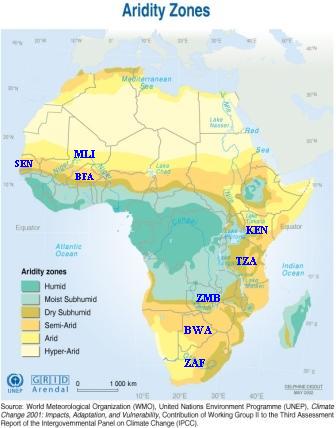
The
map above of the World Meteorological Organization,
United Nations Environment Programme, Climate
Change (2001), prepared for the Third Assessment
Report of the Intergovernmental Panel on Climate
Change, provides the most accurate delineation
of arid and semi arid areas in Africa.
The
following maps have been developed under teh
COMPETE project by the University of KwaZulu-Natal
(UKZN), South Africa.
Arid
and semi-arid areas in African countries
Spatial
extent of Global Land Covers in Africa
Land
covers unsuitable for bioenergy crops in Africa
Protected
areas unavailable for bioenergy crops
Areas
under food or cash crops unavailable for bioenergy
crops
Areas
that are unsuitable and /or unavailable for
bioenergy crops in sub-
Sahara’s arid and semi-arid regions.
Primary
roads in arid and semi-arid sub-Saharan Africa
Railway
lines in arid and semi-arid sub-Saharan Africa
Populated
places in arid and semi-arid sub-Saharan Africa